






Category D1 training prepares drivers to operate minibuses with up to 16 passenger seats for work, community transport, education and passenger-carrying roles.
Category D1 training prepares drivers to operate minibuses with up to 16 passenger seats for work, community transport, education and passenger-carrying roles.
J Coates provides Category D1 minibus training for individuals, schools, care providers, councils, charities and employers who need drivers to operate minibuses safely and legally. J Coates can help manage the process from medical and provisional entitlement through to training, test preparation and licence progression.
Category D1 Minibus Training Summary
| Licence category: | Category D1 |
| Common name: | Minibus licence |
| Vehicle type: | Minibuses with up to 16 passenger seats |
| Maximum length: | Up to 8 metres |
| Trailer: | Up to 750kg MAM |
| Suitable for: | Schools, care homes, charities, councils, community transport providers, employers and individuals |
| Competency assessments: | Available for already licensed minibus drivers |
| Driver CPC: | May be required for professional or commercial passenger transport |
| Finance: 0% | finance options may be available on selected courses, subject to eligibility and approval |
Which licence do you need to drive a minibus?
The licence needed depends on the number of passenger seats, the vehicle use and whether the driving is for work, hire or reward.
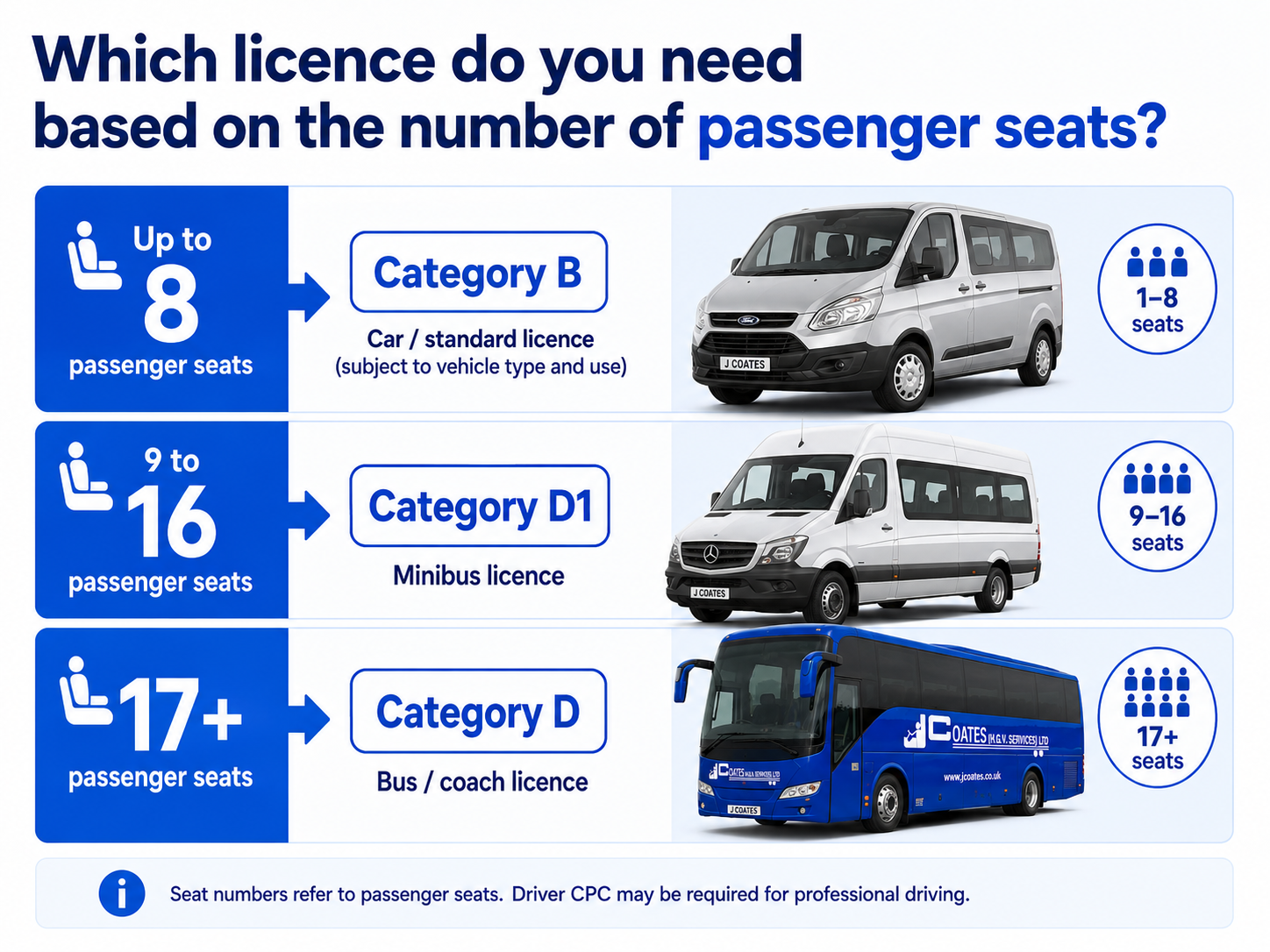
Category D1 is the licence category for minibuses with no more than 16 passenger seats. It is commonly used by schools, care homes, charities, councils, community transport providers and employers that need staff to drive minibuses.
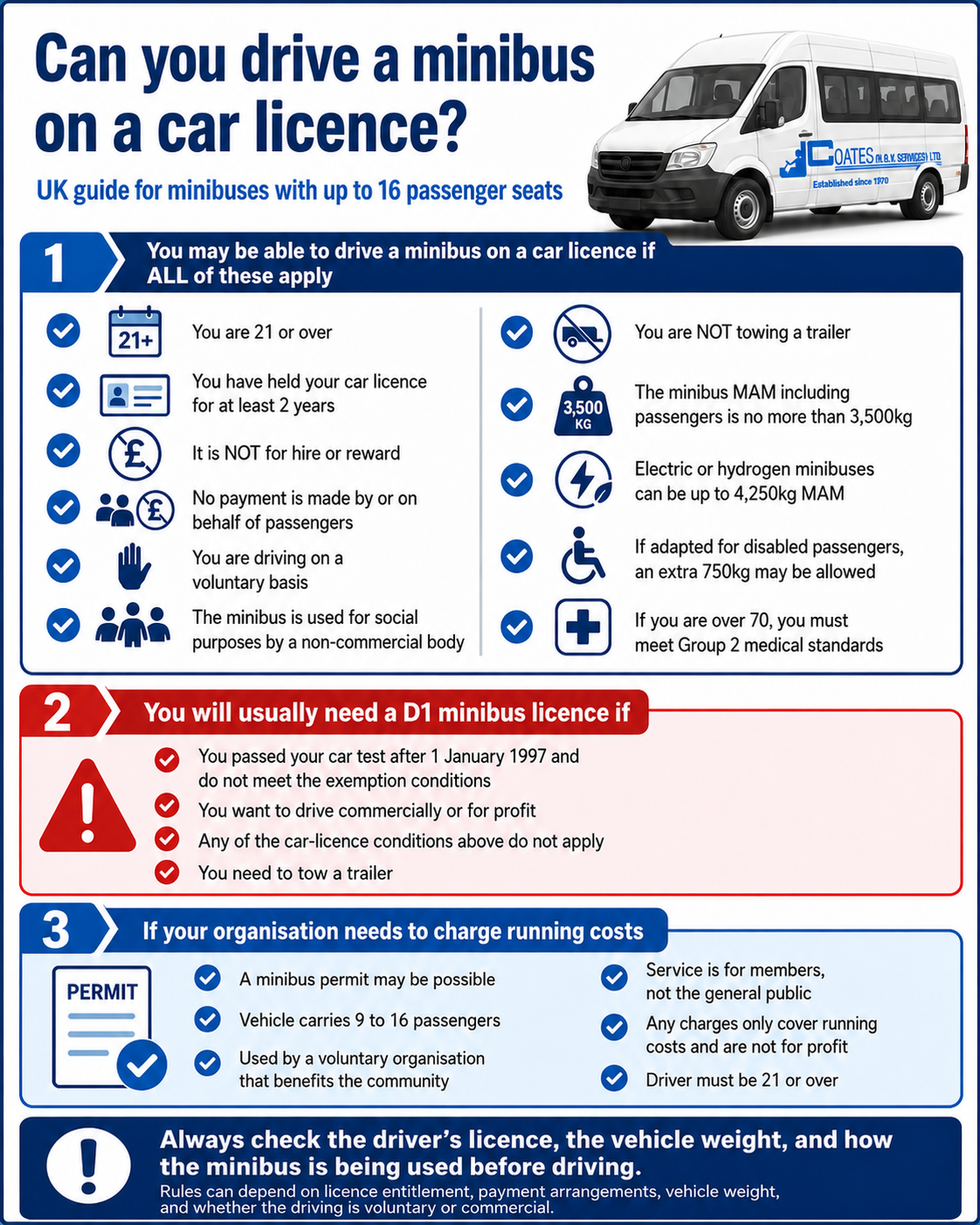
Can I drive a minibus on a car licence?
Some drivers may be able to drive a minibus on a car licence, but only in limited circumstances.
GOV.UK says you may be able to drive a minibus with up to 16 passenger seats on a car licence if it is not being used for hire or reward and there is no payment from or on behalf of passengers.
Because minibus rules depend on licence entitlement, vehicle use, passenger numbers, payment arrangements and organisation type, J Coates can help check the correct route before training or assessment is arranged.
Competency assessments for existing Category D1 minibus drivers
Some organisations already have staff with Category D1 entitlement on their driving licence, but holding the entitlement does not automatically prove that a driver is currently safe, confident or suitable to drive a minibus carrying passengers.
J Coates provides minibus competency assessments for already licensed drivers. These assessments are designed for schools, care homes, charities, councils, community transport providers and employers that need to check, refresh or record a driver’s ability before allowing them to operate a minibus.
A competency assessment can help confirm whether a driver can operate a minibus safely in real-world conditions, including passenger awareness, vehicle control, observation, road positioning, reversing, junctions, roundabouts, vehicle checks and general road safety behaviour.
Why competency assessments matter
A minibus is often used to carry students, residents, service users, employees, vulnerable passengers or members of the public. That creates a higher level of responsibility for the organisation and the driver.
Even where a driver already has Category D1 entitlement, an employer or organisation should still be satisfied that the driver is competent for the vehicle, route, passengers and operating conditions.
Competency assessments help organisations identify risks before an incident happens. They can also highlight where a driver may need refresher training, confidence building or further instruction before being approved to drive.
Employer legal responsibilities for minibus drivers
Employers and organisations have a responsibility to manage the risks created by work-related driving. The Health and Safety Executive states that employers must manage health and safety risks for workers who drive as part of a work activity, and that health and safety law applies to work activities on the road in the same way as it does on a fixed site. {index=0}
Employers must also consider the safety of other people who may be affected by their work-related driving activities, including passengers, pedestrians and other road users. HSE guidance explains that employers have duties under health and safety law for on-the-road work activities and must ensure, so far as reasonably practicable, the health and safety of employees while at work.
For minibus operators, this means it is not enough to simply assume a driver is suitable because they hold a licence. Organisations should be able to show that they have checked the driver’s entitlement, assessed the driving risk, provided suitable guidance or training, and taken reasonable steps to ensure the driver is competent.
What a Category D1 competency assessment can cover
A J Coates minibus competency assessment can review areas such as:
Licence and entitlement checks
Driver confidence and attitude
Vehicle familiarisation
Daily walkaround checks
Mirror use and observation
Road positioning and lane discipline
Junctions and roundabouts
Speed awareness and braking
Reversing and low-speed manoeuvring
Passenger comfort and safety awareness
Seatbelt and loading awareness
Route risk awareness
Emergency and breakdown awareness
Safe conduct around vulnerable passengers
Competency assessments for schools, care providers, charities and employers
Competency assessments for schools, care providers, charities and employers
Minibus competency assessments are particularly useful for organisations that carry passengers as part of their normal operations. This can include schools, colleges, care homes, charities, local authorities, community transport providers, sports clubs and employers operating staff transport.
A competency assessment can help the organisation keep a clear record that the driver has been checked and that any training needs have been identified. This can support internal transport policies, insurance requirements, safeguarding responsibilities and general duty of care procedures.
Where staff or volunteers are driving minibuses under Section 19 or Section 22 permit arrangements, organisations still need to make sure the service is operated legally and safely. GOV.UK guidance says permit holders are responsible for ensuring services are operated within the law, vehicles are properly maintained and drivers have the appropriate qualifications.
Competency assessment vs full Category D1 licence training
A competency assessment is not the same as a Category D1 driving test.
A competency assessment is for someone who already has the correct entitlement and needs their driving ability checked, refreshed or recorded.
Full Category D1 training is for someone who needs to gain the D1 entitlement through the formal licence and test process.
J Coates can help confirm which route is needed based on the driver’s licence, the minibus being used, passenger numbers, vehicle weight, whether payment is involved and whether the driving is voluntary, work-related or commercial.
Book a minibus competency assessment
Speak to J Coates if your organisation needs to check existing minibus drivers, refresh staff confidence or record driver competence before allowing staff to drive passengers.
J Coates can advise whether your driver needs a competency assessment, refresher training or full Category D1 licence training.
Who is Category D1 training for?
Category D1 training is suitable for people who need to drive minibuses as part of their work or organisation.
This can include school staff, care home staff, local authority workers, community transport drivers, charity drivers, private hire passenger transport staff, employers with staff transport vehicles and individuals who need formal minibus entitlement.
Category D1 training entry requirements
Before starting Category D1 training, learners need to meet the correct licence, medical, provisional entitlement and test requirements.
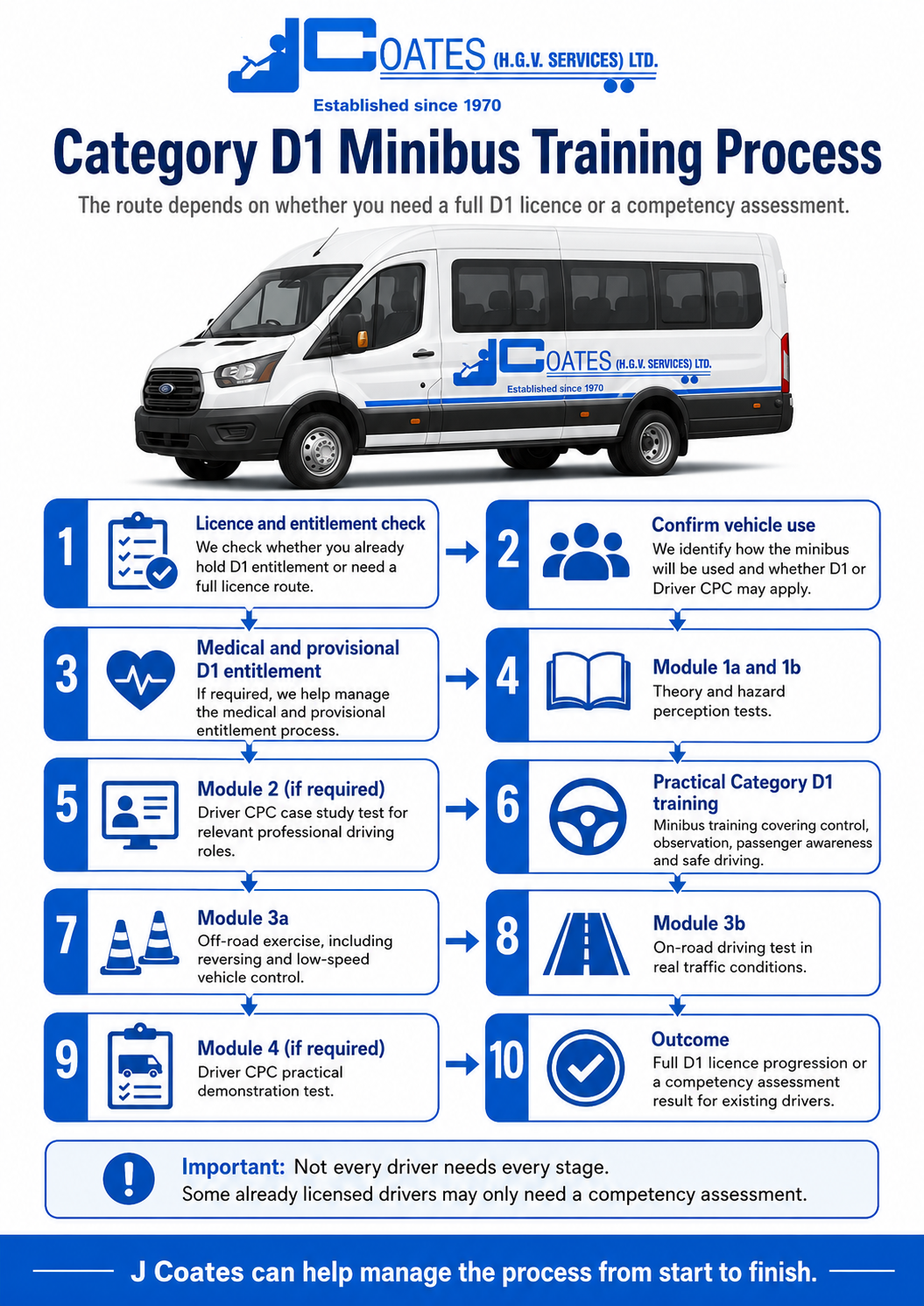
J Coates can fully manage the process from start to finish, helping both individual learners and organisations complete each stage accurately and efficiently. This includes support with the required paperwork, medical, provisional licence entitlement, theory test preparation, practical training and test booking process.
Learners may need:
A valid UK driving licence
The correct provisional D1 entitlement
A completed driver medical
The relevant theory and hazard perception tests
Driver CPC if required for professional or commercial passenger transport
Suitable identification for training and test booking
For schools, care providers, charities, councils and employers investing in staff training, J Coates can help coordinate the learner journey, reduce administrative pressure and support smooth progression from initial enquiry through to practical test.
For individuals, the managed process helps reduce confusion, avoid avoidable delays and make the route into Category D1 minibus driving clearer from the start.
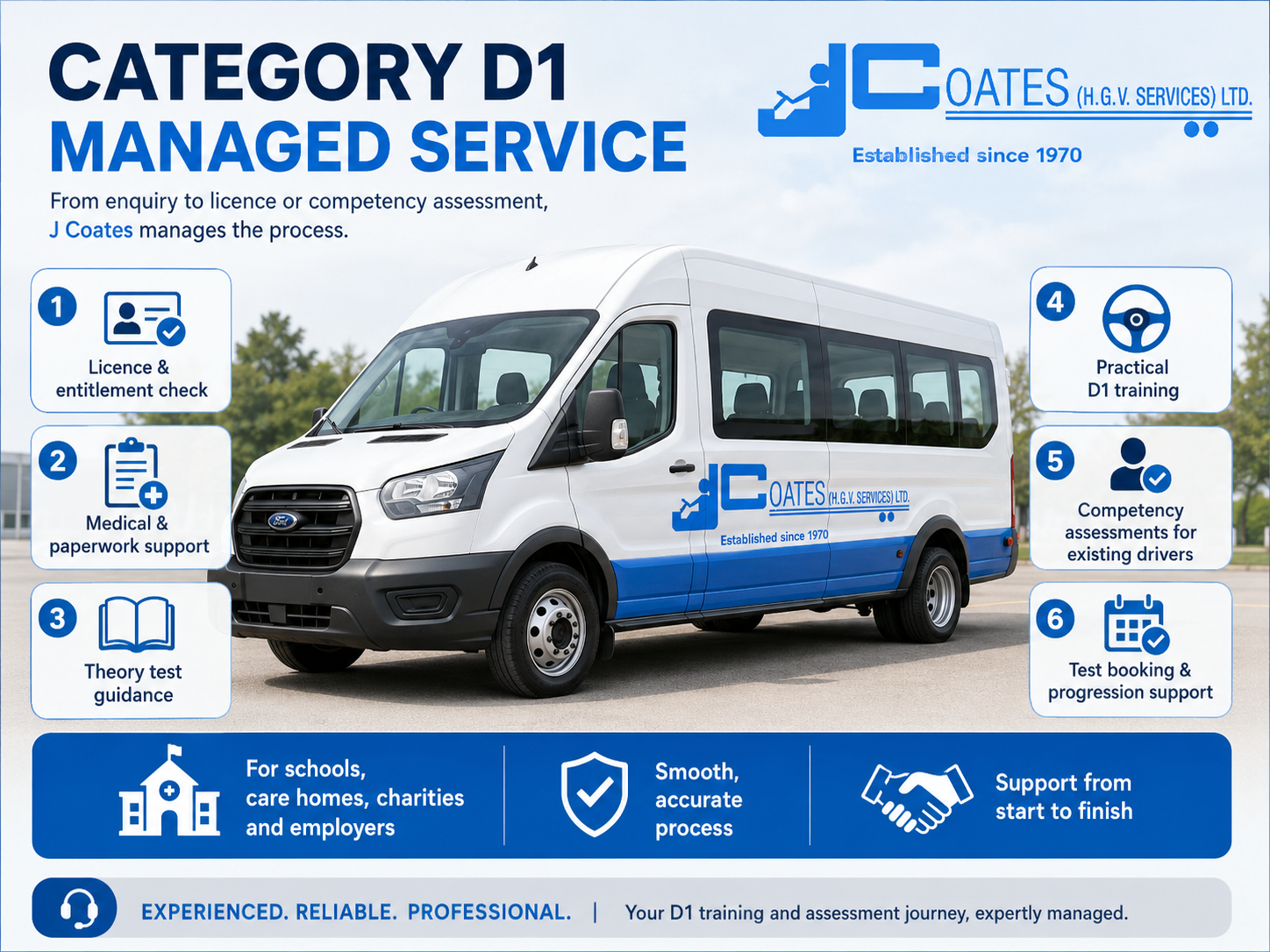
Category D1 training process
The Category D1 minibus training process depends on whether the driver already has the correct entitlement or needs to gain a full D1 licence. J Coates can help individuals, schools, care providers, charities, councils and employers identify the correct route before training or assessment is arranged.
1. Licence and entitlement check
The first stage is to check the driver’s current licence entitlement and confirm whether they already hold Category D1, need a competency assessment, or need to apply for provisional D1 entitlement.
Some drivers who passed their car test before 1 January 1997 may have D1 entitlement already, often with restrictions. Drivers who passed their car test after 1 January 1997 usually need to apply for minibus provisional entitlement if they want to gain a D1 licence.
J Coates can help check the driver’s licence position and advise whether the correct route is full D1 training, refresher training or a competency assessment.
2. Confirm how the minibus will be used
Before training is booked, it is important to understand how the minibus will be used. The rules can depend on whether the driving is voluntary, work-related, commercial, for hire or reward, or operated under a permit.
GOV.UK says some drivers may be able to drive a minibus with up to 16 passenger seats on a car licence if there is no payment from or on behalf of passengers, and the relevant conditions are met. If the minibus is being driven commercially, or the conditions do not apply, a minibus provisional entitlement may be needed.
J Coates can help organisations understand whether the driver needs Category D1 training, Driver CPC, a competency assessment or further advice before operating the vehicle.
3. Medical and provisional D1 entitlement
Drivers who need to gain Category D1 entitlement will normally need to complete the driver medical and provisional entitlement process before practical training can begin.
This usually includes the correct licence application forms, a medical examination and submission of the required paperwork to DVLA. J Coates can help manage this process so that paperwork is completed accurately and avoidable delays are reduced.
4. Module 1a and 1b: theory and hazard perception test
Learners working towards a Category D1 licence need to prepare for and pass the relevant theory and hazard perception tests.
These tests assess knowledge of road safety, hazard awareness, passenger safety, vehicle control and professional driving responsibilities. J Coates can advise learners on the correct preparation route before practical minibus training begins.
5. Module 2: Driver CPC case study test, if required
Some drivers will need Driver CPC if they are driving professionally or commercially. Where Driver CPC is required, the learner may need to complete Module 2, the Driver CPC case study test.
This test uses realistic passenger transport scenarios to assess how a driver should respond in different situations. J Coates can help identify whether Driver CPC applies based on the driver’s role, vehicle use and operating circumstances.
6. Practical Category D1 minibus training
Practical Category D1 training helps learners build the skills needed to drive a minibus safely and confidently.
Training can include vehicle familiarisation, daily walkaround checks, seating and passenger awareness, observation, mirror use, junctions, roundabouts, road positioning, speed control, braking, reversing, low-speed manoeuvring and safe on-road driving.
The aim is to prepare the learner for the D1 practical test and to help them operate a minibus safely in real-world conditions.
7. Module 3a: off-road exercise
Module 3a is the off-road practical exercise. For Category D1, this can include reversing and safe control of the minibus in the test area.
This stage checks that the learner can control the vehicle accurately at low speed and complete the required manoeuvre safely.
8. Module 3b: on-road driving test
Module 3b is the on-road practical driving test. It assesses whether the learner can drive a Category D1 minibus safely and competently on public roads.
The test can include normal road driving, junctions, roundabouts, lane discipline, mirrors, observations, speed control, positioning and general safe driving behaviour.
9. Module 4: Driver CPC practical demonstration test, if required
Learners who need Driver CPC may also need Module 4. This is the Driver CPC practical demonstration test.
For minibus and passenger-carrying vehicle drivers, Module 4 can cover areas such as vehicle safety, passenger safety, emergency procedures, legal responsibilities, load and luggage awareness, and professional driver procedures.
10. Licence progression or competency assessment outcome
Once the required training and tests are completed, the driver can progress towards the correct D1 entitlement and, where needed, Driver CPC qualification.
For already licensed drivers completing a competency assessment, J Coates can provide feedback on driving ability, confidence, safety, control and any further training needs. This helps organisations keep a record of driver competence and identify whether a driver is suitable to operate a minibus for their role.
J Coates supports both individuals and organisations by helping plan the correct route, manage each stage and support smooth progression through the Category D1 minibus training or assessment process.
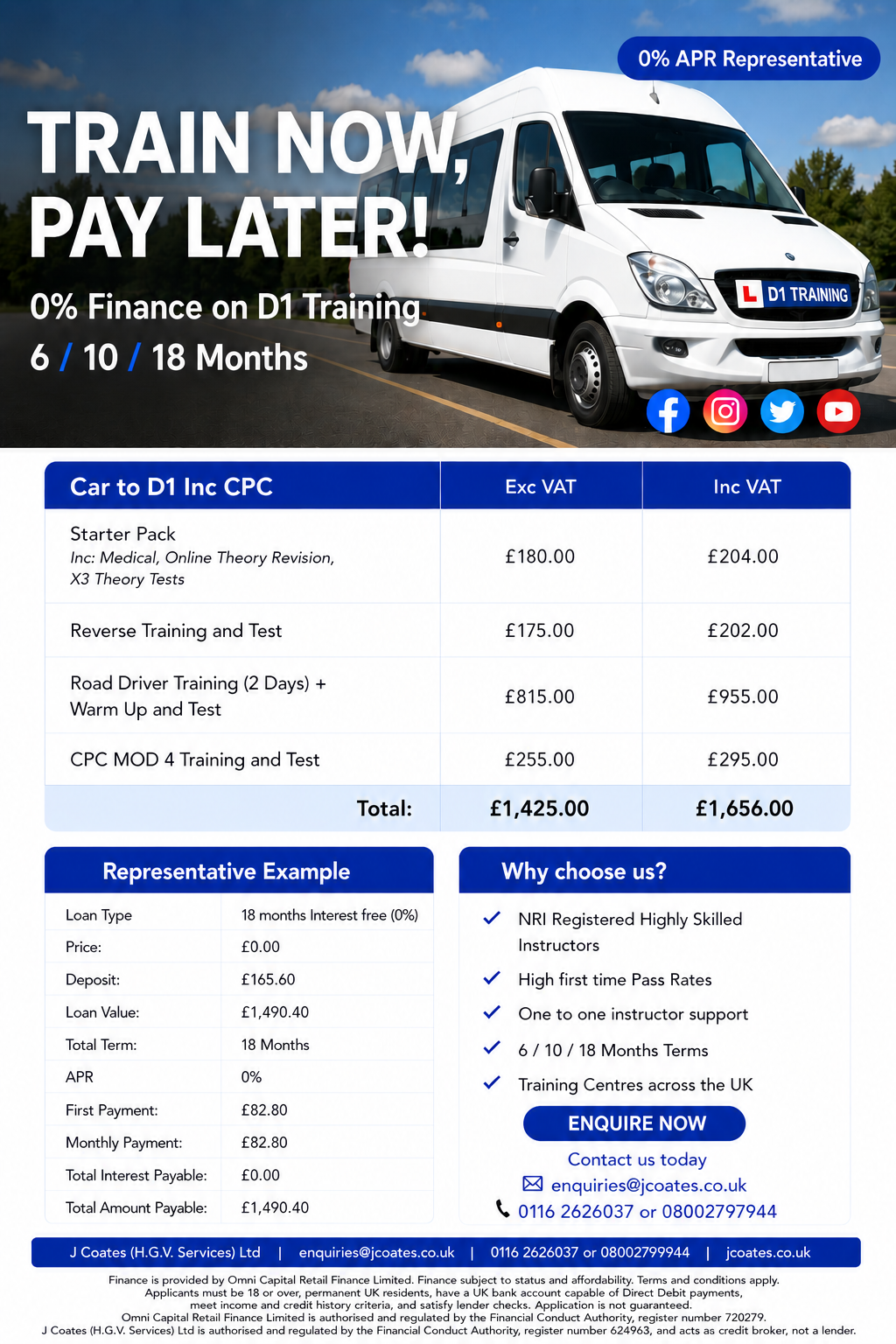
0% finance for Category D1 training
J Coates offers 0% finance options on selected private driver training bookings, helping learners spread the cost of professional driver training instead of paying the full course cost upfront.
Finance may be available for HGV, LGV, PCV, minibus and other eligible driver training courses, subject to status, eligibility and approval. A deposit may be required, and repayment terms may be available over 6, 10 or 18 months, depending on the course package and finance approval.
Finance can help learners start their training sooner, manage the cost of licence acquisition and plan their route into professional driving with clearer monthly payments.
Training locations
Birmingham
Coventry
Guildford
Hinckley
Leicester
Melton Mowbray
Newark
Northampton
Oxford
St Albans
Slough
Frequently asked questions about Category D1 minibus training
What is Category D1 training?
Category D1 training prepares drivers to operate minibuses with up to 16 passenger seats. It is commonly used by schools, care homes, councils, charities, community transport providers and employers.
Is Category D1 the same as Category D?
No. Category D1 is usually for minibuses with up to 16 passenger seats, while Category D is for buses and coaches with more than 8 passenger seats. J Coates can advise which licence is required based on the vehicle, passenger numbers and how it will be used.
What vehicles can I drive with Category D1?
Category D1 allows drivers to operate minibuses with no more than 16 passenger seats, up to 8 metres long, with a trailer up to 750kg MAM.
Can I drive a minibus on a car licence?
Sometimes. Some drivers may be able to drive a minibus with up to 16 passenger seats on a car licence if strict conditions are met, including that it is not for hire or reward and no payment is made by or on behalf of passengers. J Coates can help check whether D1 training or assessment is required.
Do drivers who passed their car test before 1 January 1997 have D1?
Many drivers who passed their car test before 1 January 1997 may have acquired D1 entitlement, often with restriction code 101, which means not for hire or reward. The driver’s licence should always be checked before they drive a minibus.
Do drivers who passed after 1 January 1997 need Category D1?
Usually, yes, if they need to drive a minibus and do not meet the limited car-licence exemption conditions. J Coates can help confirm whether the driver needs full D1 training, Driver CPC or a competency assessment.
Do already licensed minibus drivers need a competency assessment?
Not always, but many employers and organisations choose to assess minibus drivers as part of their duty of care and internal safety procedures. A competency assessment can help confirm that a driver is safe, confident and suitable to operate a minibus.
Is a competency assessment the same as a D1 driving test?
No. A competency assessment checks the ability of an already licensed driver. A D1 driving test is for learners who need to gain the licence entitlement.
Can school staff drive a minibus on a car licence?
Sometimes, but only if the driver, vehicle and journey meet the relevant rules. Schools should check the driver’s licence entitlement, passenger numbers, vehicle weight, payment arrangements and whether the journey is for hire or reward.
Can care home staff drive a minibus on a car licence?
Sometimes, but the rules depend on the driver’s licence, the vehicle, the passengers, whether payment is involved and whether the driving is part of paid work. Care providers should check carefully before allowing staff to drive residents or service users.
Do I need Driver CPC for Category D1?
Driver CPC may be required if the minibus driving is professional, commercial or part of paid passenger transport work. J Coates can advise whether Driver CPC applies to your situation.
Who needs full Category D1 training?
Full Category D1 training is usually needed where a driver does not already have D1 entitlement or where an organisation needs drivers to gain formal minibus licence entitlement for work, passenger transport or operational requirements.
Can companies book Category D1 training for staff?
Yes. J Coates can support employers, schools, care providers, charities, councils and community transport organisations that need staff to gain Category D1 entitlement or complete minibus competency assessments.
How long does Category D1 training take?
Category D1 training length depends on the driver’s experience, licence status, confidence and test readiness. The wider process can also depend on DVLA processing, medical completion, theory test availability and practical test availability.
Where can I take Category D1 training?
J Coates offers Category D1 training and minibus competency assessments across its training centre network. Contact the team to confirm the nearest suitable location, course dates and availability.
How do I book Category D1 training or a competency assessment?
Contact J Coates to discuss whether you need full Category D1 training, a minibus competency assessment or advice on licence requirements. The team can help identify the correct route for the driver, vehicle and organisation.
Book Category D1 minibus training or a competency assessment
Speak to J Coates about Category D1 minibus training, competency assessments, course dates, prices, finance options and the correct route for your organisation or driving needs.
