






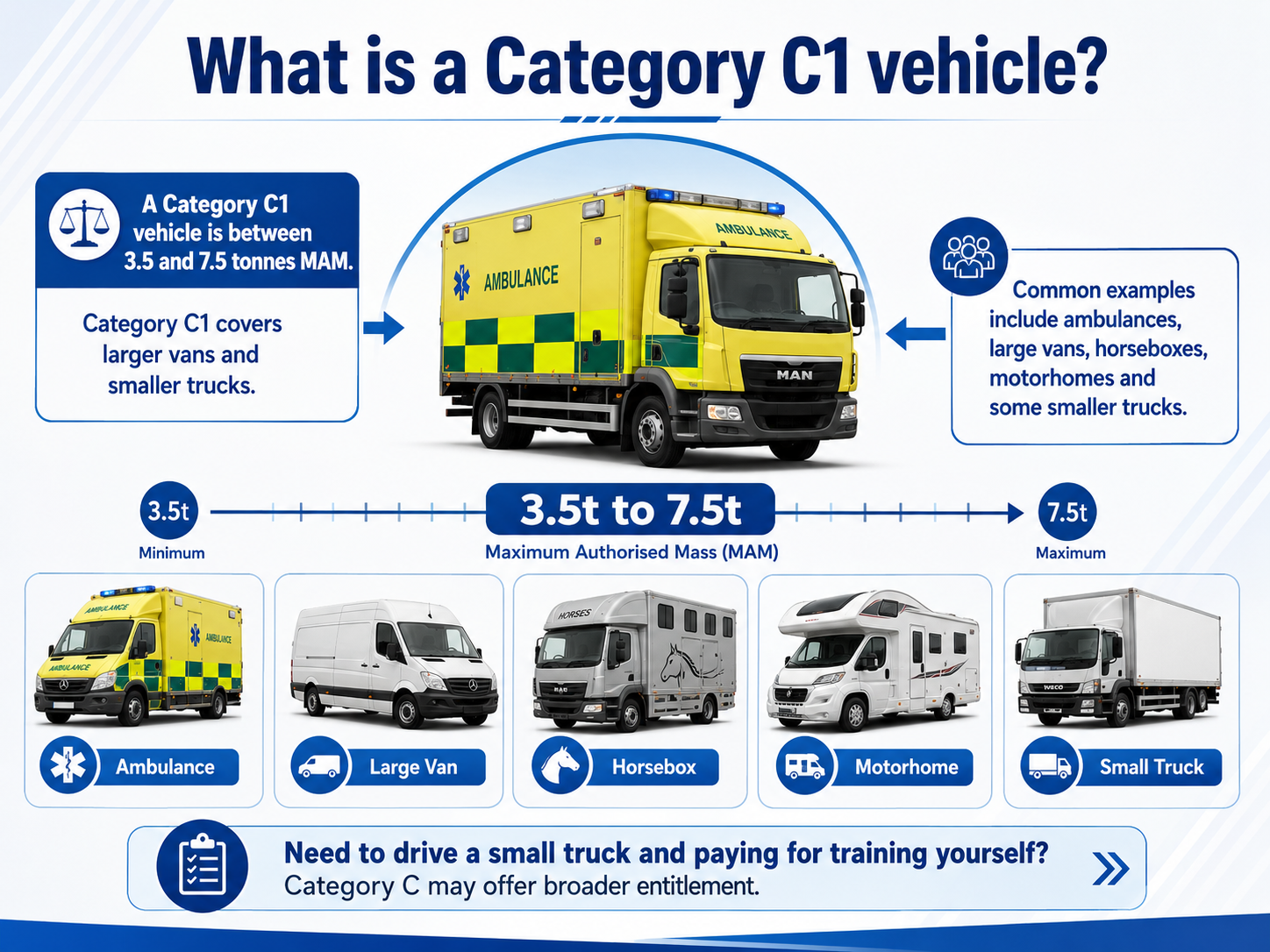
Category C1 training prepares drivers to operate vehicles between 3.5 and 7.5 tonnes, including ambulances, large vans, horseboxes, motorhomes and some smaller commercial trucks.
J Coates provides Category C1 driver training for ambulance drivers, NHS Trusts, private ambulance providers, patient transport services, specialist vehicle operators, employers and individuals who need to gain C1 licence entitlement.
Category C1 Training Summary
| Licence category: | Category C1 |
| Vehicle type: | Vehicles between 3.5 and 7.5 tonnes MAM |
| Trailer: | Up to 750kg MAM |
| Common uses: | Ambulances, large vans, horseboxes, motorhomes, specialist vehicles and some 7.5 tonne trucks |
| Best suited for: | Ambulance drivers, NHS Trust staff, private ambulance operators, patient transport drivers and drivers who only need C1 entitlement |
| Alternative route: | Self-funded learners wanting to drive small trucks may wish to consider Category C / Class 2 for broader entitlement |
| Driver CPC: | May be required for professional driving a Ambulance driver would not need DCPC |
| Finance: | 0% finance options may be available on selected private bookings, subject to status, eligibility and approval |
| Locations: | Birmingham, Coventry, Guildford, Hinckley, Leicester, Melton Mowbray, Newark, Northampton, Oxford, St Albans and Slough |
What is Category C1?
Category C1 is the licence category for vehicles between 3.5 and 7.5 tonnes MAM. It is often used for ambulances, large vans, horseboxes, motorhomes, specialist service vehicles and some smaller rigid trucks.
Category C1 is not the same as Category C / Class 2. Category C1 is limited to vehicles up to 7.5 tonnes, while Category C gives wider entitlement for rigid goods vehicles over 3.5 tonnes.
Who is Category C1 training for?
Category C1 training is suitable for drivers who need to operate vehicles between 3.5 and 7.5 tonnes.
This can include:
Ambulance drivers
NHS Trust staff
Private ambulance providers
Patient transport drivers
Emergency service support staff
Large van drivers
Horsebox drivers
Motorhome drivers
Specialist vehicle operators
Employer-funded trainees
Individuals who need C1 entitlement for work
Category C1 training entry requirements
Before starting Category C1 training, learners need to meet the correct licence, medical, provisional entitlement and test requirements.
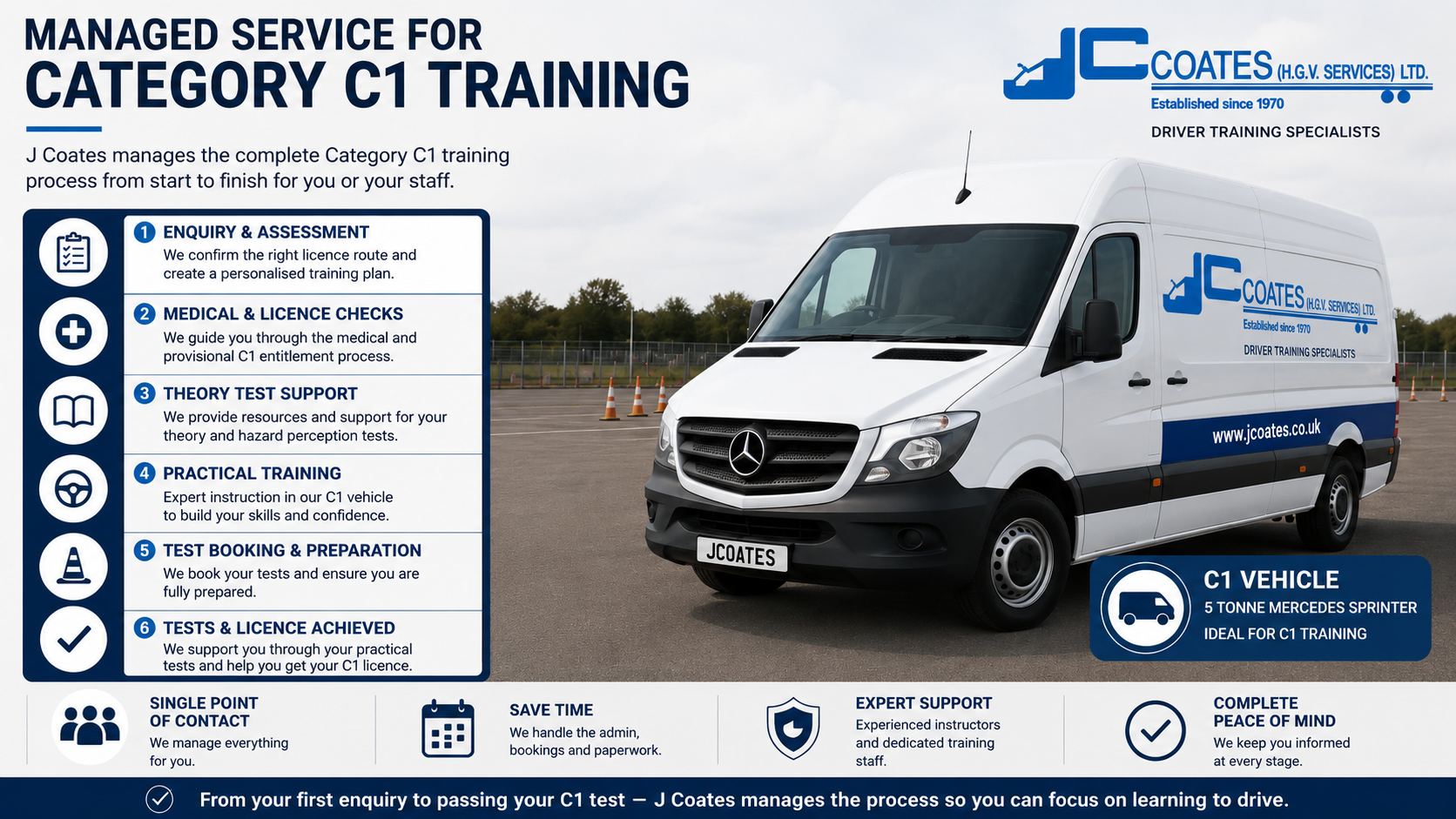
J Coates can fully manage the process from start to finish, helping both individual learners and employers complete each stage accurately and efficiently. This includes support with the required paperwork, medical, provisional licence entitlement, theory test preparation, practical training and test booking process.
Learners may need:
A valid UK driving licence
The correct provisional C1 entitlement
A completed driver medical
The relevant theory and hazard perception tests
Driver CPC if they want to drive professionally
Suitable identification for training and test booking
For NHS Trusts, ambulance providers, healthcare organisations and employers investing in staff training, J Coates can help coordinate the learner journey, reduce administrative pressure, identify the correct training route and support smooth progression from initial enquiry through to practical test.
For individuals, the managed process helps reduce confusion, avoid avoidable delays and make the route into Category C1 driving clearer from the start.
Category C1 training process
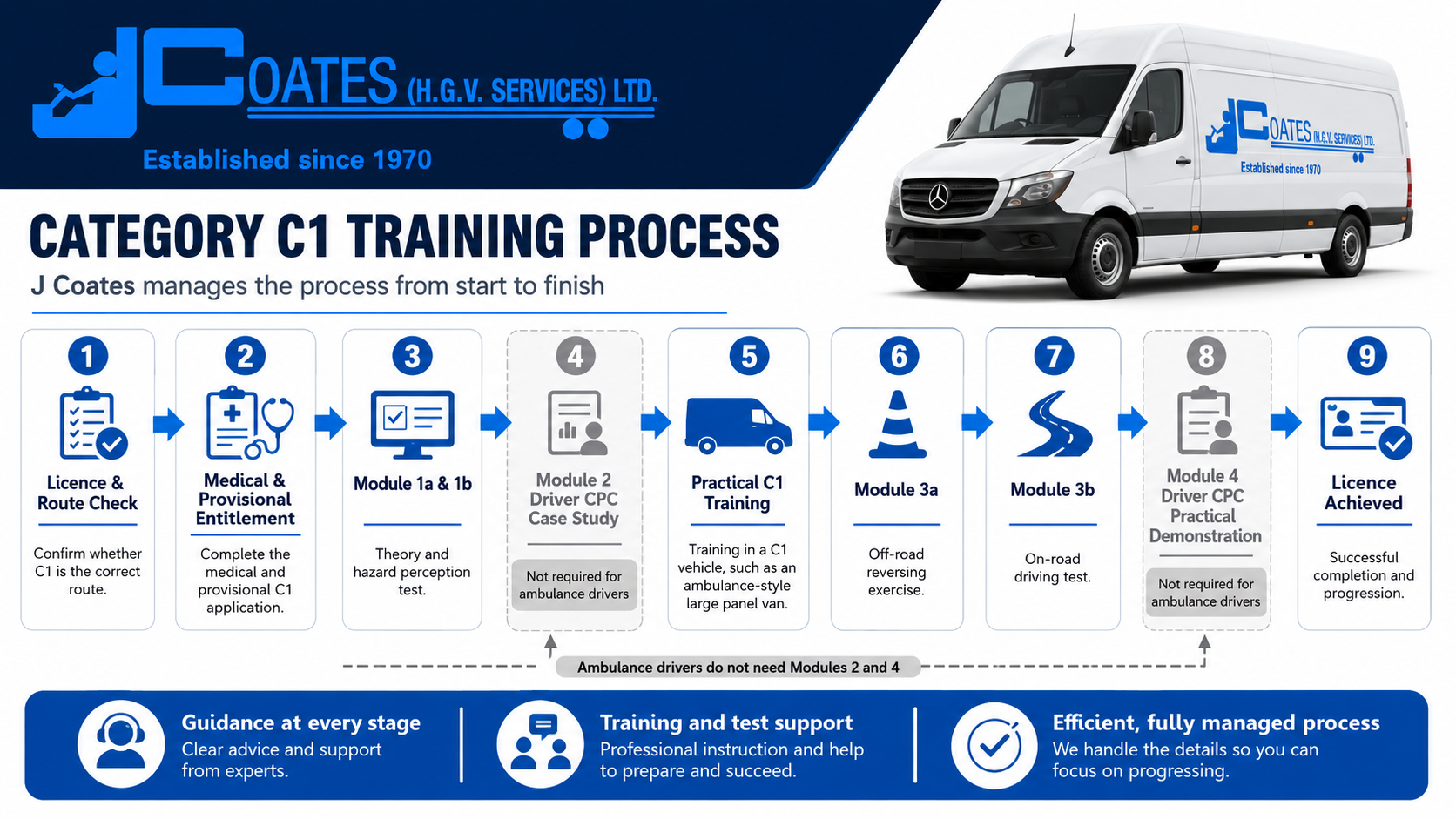
The Category C1 training process usually involves several DVSA test stages. J Coates can help manage the process from start to finish, making sure each stage is completed accurately and efficiently.
1. Licence and route check
J Coates can help confirm whether Category C1 is the correct licence route or whether Category C / Class 2 would be better value based on the vehicle, employer requirement and learner’s long-term goals.
2. Medical and provisional entitlement
Before practical training can begin, learners need the correct medical, licence application and provisional C1 entitlement. J Coates can help individuals and employers understand what is required and keep the process moving.
3. Module 1a and 1b: theory and hazard perception test
Learners need to prepare for and pass the relevant theory and hazard perception tests. These tests check knowledge of road safety, vehicle handling, hazard awareness and professional driving responsibilities.
4. Module 2: Driver CPC case study test, if required
Learners who want or need to drive professionally may need to complete the Driver CPC case study test. This test uses realistic professional driving scenarios to assess how a driver should respond in different situations. This is not needed to drive an ambulance.
5. Practical Category C1 training
J Coates provides practical Category C1 training in a suitable vehicle, helping learners build the skills needed for vehicle control, road positioning, observation, mirrors, junctions, roundabouts, reversing and safe on-road driving.
For ambulance and patient transport learners, training can help develop the confidence needed to operate larger vehicles safely and professionally.
6. Module 3a: off-road reversing exercise
Module 3a covers the off-road practical exercise. For Category C1, this can include the reversing manoeuvre and safe control of the vehicle in the test area.
7. Module 3b: on-road driving test
Module 3b is the on-road practical driving test. It assesses whether the learner can drive a Category C1 vehicle safely and competently on public roads.
8. Module 4: Driver CPC practical demonstration test, if required
Learners who need Driver CPC for professional driving may also need Module 4. This practical demonstration test checks knowledge of vehicle safety, load security, legal responsibilities and professional driver procedures. This is not needed to drive an ambulance.
J Coates supports both individual learners and organisations by helping plan the correct route, manage the stages and support smooth progression through the Category C1 training process.
How long does Category C1 training take?
Category C1 course length depends on the learner’s experience, current licence status, test readiness and whether Driver CPC is required.
Practical training is usually planned around the learner’s confidence, vehicle control, road awareness and test preparation needs. Ambulance and patient transport learners may have specific employer requirements, which J Coates can help manage as part of the training process.
The full process from medical and provisional entitlement through to completing the required test modules is usually around 8–12 weeks, depending on DVLA processing, theory test availability, practical test availability and learner progress.
0% finance for Category C1 training
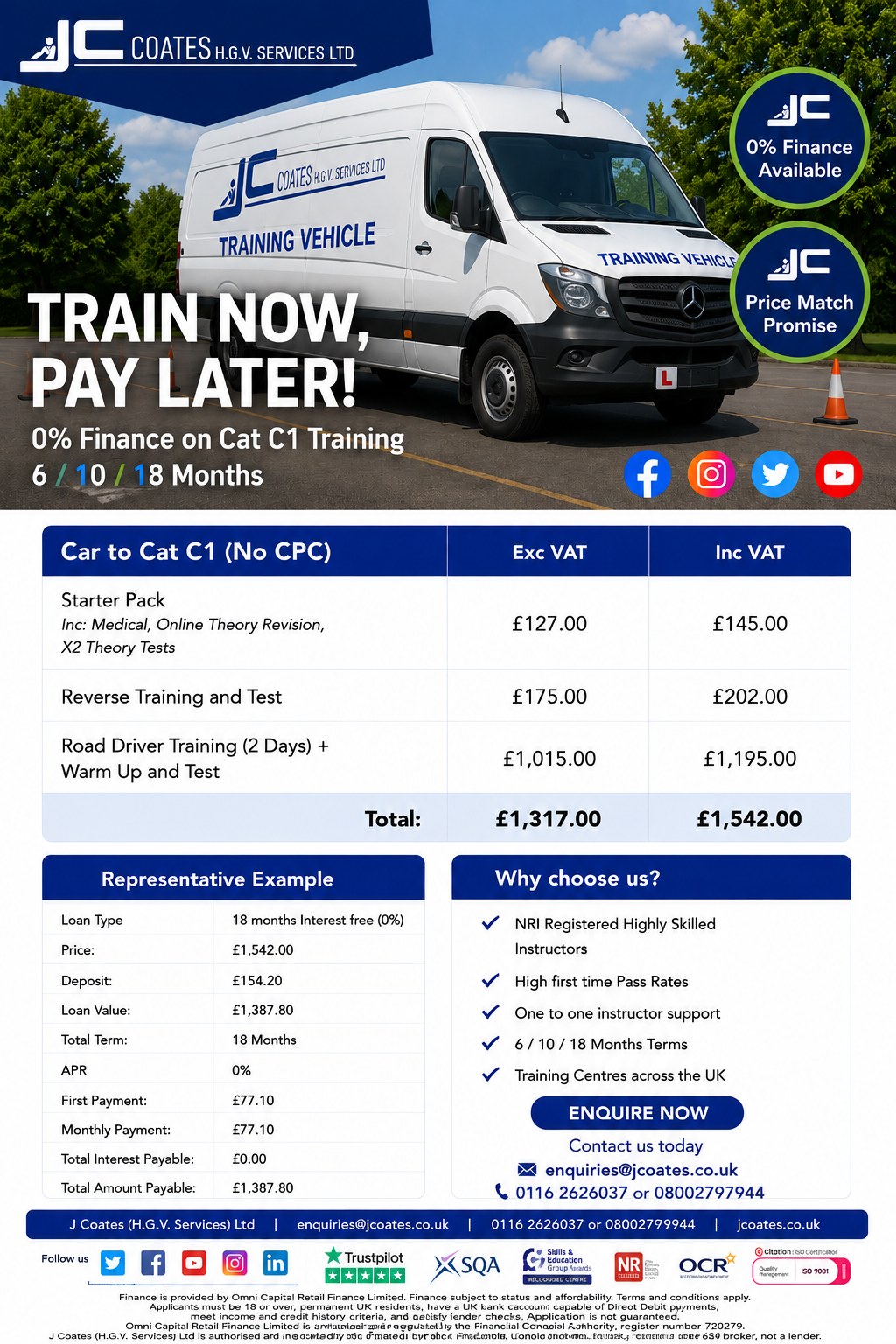
J Coates offers 0% finance options on selected private driver training bookings, subject to status, eligibility and approval.
Finance may help private learners spread the cost of Category C1 training rather than paying the full course cost upfront. J Coates is authorised and regulated by the Financial Conduct Authority and acts as a credit broker, not a lender.
Employers, NHS Trusts and organisations should contact J Coates directly to discuss staff training arrangements, framework agreements and group booking options.
Category C1 training locations
J Coates offers Category C1 training through its training centre network. Learners and organisations can contact their nearest J Coates location to discuss course dates, availability, prices and finance options.
Category C1 training locations include Birmingham, Coventry, Guildford, Hinckley, Leicester, Melton Mowbray, Newark, Northampton, Oxford, St Albans and Slough.
Why train with J Coates?
J Coates has many years of experience delivering professional HGV, LGV, PCV, ambulance driver and vocational licence training across multiple UK training centres.
J Coates has framework agreements with NHS Trusts across the country and understands the importance of accurate licence progression, reliable training delivery and efficient administration for healthcare and emergency service organisations.
Learners receive practical training, test preparation and course guidance from an established commercial driver training provider. J Coates can also support employers who need to train staff for ambulance, patient transport, specialist vehicle or commercial driving roles.
Frequently asked questions about Category C1 training
What is Category C1 training?
Category C1 training prepares drivers to operate vehicles between 3.5 and 7.5 tonnes. It is commonly used for ambulances, large vans, horseboxes, motorhomes, specialist vehicles and some smaller rigid trucks.
Is Category C1 used for ambulance driving?
Yes. Category C1 is commonly required for ambulance driving because many ambulances are over 3.5 tonnes but do not exceed 7.5 tonnes. J Coates provides C1 training for ambulance drivers, NHS Trust staff and private ambulance providers.
What vehicles can I drive with Category C1?
Category C1 allows drivers to operate vehicles between 3.5 and 7.5 tonnes MAM, with a trailer up to 750kg. This can include ambulances, large vans, motorhomes, horseboxes and some smaller commercial trucks.
Should I take Category C1 or Category C?
If you only need to drive vehicles between 3.5 and 7.5 tonnes, such as an ambulance or specialist large van, Category C1 may be suitable. If you are self-funding and want to drive small trucks, Category C may be better value because it gives broader rigid lorry entitlement and also covers C1 vehicles.
Does a Category C licence cover C1 vehicles?
Yes. Category C is a higher goods vehicle category and allows drivers to drive vehicles that fall within Category C1, subject to the correct entitlement and any professional driving requirements.
Do I need Driver CPC for Category C1?
Driver CPC may be required if you want to drive Category C1 vehicles professionally. J Coates can advise whether you need Initial Driver CPC, Periodic Driver CPC or both.
How long does Category C1 training take?
Category C1 training length depends on your experience, licence status and test readiness. The wider process can also depend on DVLA processing, medical completion, theory test availability and practical test availability.
Do J Coates provide C1 training for NHS Trusts?
Yes. J Coates has framework agreements with NHS Trusts across the country and provides Category C1 training for ambulance drivers, patient transport staff and healthcare transport roles.
Can private ambulance companies book C1 training?
Yes. J Coates can support private ambulance providers, patient transport operators and healthcare organisations that need staff to gain Category C1 entitlement.
Do you offer 0% finance for Category C1 training?
Yes. J Coates offers 0% finance options on selected private driver training bookings, subject to status, eligibility and approval. Contact the team to confirm availability and monthly payment options.
Where can I take Category C1 training?
J Coates offers Category C1 training across its training centre network, including Birmingham, Coventry, Guildford, Hinckley, Leicester, Melton Mowbray, Newark, Northampton, Oxford, St Albans and Slough.
Book Category C1 training
Speak to J Coates about Category C1 training, ambulance driver training, NHS framework training, course dates, prices, finance options and the best route for your vehicle or staff training needs.
Contact the team today to discuss your licence goals, employer requirements and nearest training location.
